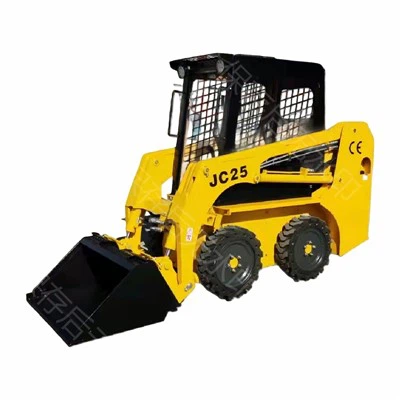

A skid steer loader is a versatile piece of construction equipment. Its core principle lies in combining flexible movement and powerful loading capabilities through a unique skid steering design and an efficient hydraulic system.
The defining characteristic of a skid steer loader is its zero-radius turning, achieved by differential control of the drive wheels on either side, allowing it to turn in place. The principle is based on:
Independent drive system: The left and right wheels are driven by independent hydraulic motors. During turning, one wheel rotates forward while the other rotates backward, creating a "skidding" effect.
Hydraulic closed-loop control: Pressure oil from the hydraulic pump is distributed to the motors on both sides via proportional valves. The flow rate is adjusted in real-time according to the steering angle, ensuring smooth turning.
Compact wheelbase design: The wheelbase is typically between 1.2 and 1.8 meters (e.g., common models have a wheelbase of approximately 1.5 meters). The short wheelbase, combined with skid steering, significantly reduces the turning radius, to as little as 1.8 meters or less, far smaller than traditional loaders.